 Skip to content
Uncategorized
How Much Does Livestock Cost in 2026? (Cattle, Sheep, Goats & Pigs Prices)
Mar
Guides to Buying Livestock Online in 2026: Cattle, Sheep, Goats & Pigs
The livestock industry is evolving rapidly. Gone are the days when buying a herd meant spending weeks traveling to dusty auction yards and local markets. In 2026, the smartest farmers and ranchers are turning to digital solutions to stock their pastures. Whether you are a seasoned cattleman looking for specific genetics or a new farmer buying your first flock of goats, buying livestock online offers unparalleled convenience, selection, and transparency .
At OrderLivestock.com, we bridge the gap between quality breeders and serious buyers. This comprehensive guide is designed to help you navigate the 2026 market. We will provide you with current pricing insights, breed recommendations, and essential buyer tips to ensure you get the best value for your investment. We will be analyzing livestock prices 2026, breaking down the cattle price per head, sheep price per head, and goat price per head, and showing you why online platforms are the future of livestock trading.
Table of Contents
-
Why Buy Livestock Online in 2026?
-
Understanding 2026 Livestock Market Prices
-
Cattle Market Overview & Cattle Price Per Head
-
Sheep Market Overview & Sheep Price Per Head
-
Goat Market Overview & Goat Price Per Head
-
Pig Market Overview
-
-
Complete Buyer’s Guides by Species
-
How to Buy Cattle: Breeds and Tips
-
How to Buy Sheep: Breeds and Tips
-
How to Buy Goats: Breeds and Tips
-
How to Buy Pigs: Breeds and Tips
-
-
Essential Farm Tips for New Stock
-
Frequently Asked Questions (FAQ)
-
Conclusion: Secure Your Livestock Today
Why Buy Livestock Online in 2026?
The shift toward digital marketplaces is driven by clear benefits for both buyers and sellers . Here is why you should consider ordering your next animals through OrderLivestock.com:
-
Wider Selection: Access to breeds and genetics from across the country, not just your local area. You can find specific traits like parasite resistance in sheep or heat tolerance in cattle .
-
Transparency and Information: Online listings provide detailed health records, weights, and high-quality photos/videos, allowing for informed decisions .
-
Convenience and Efficiency: Bid and buy from the comfort of your home. No need to take an entire day off for a sale barn that may not have what you need .
-
Better Prices: Online platforms create true price discovery, often resulting in fairer prices for top-quality stock .
-
Reduced Animal Stress: By arranging direct farm-to-farm shipping, animals are transported once, directly to you, avoiding the stress of multiple handling facilities .
Understanding 2026 Livestock Market Prices
Staying informed about current market rates is crucial for making smart purchases. Prices fluctuate based on weight, breed, age, and season. Below, we analyze the market trends for 2026 using the latest auction data.
Cattle Market Overview & Cattle Price Per Head
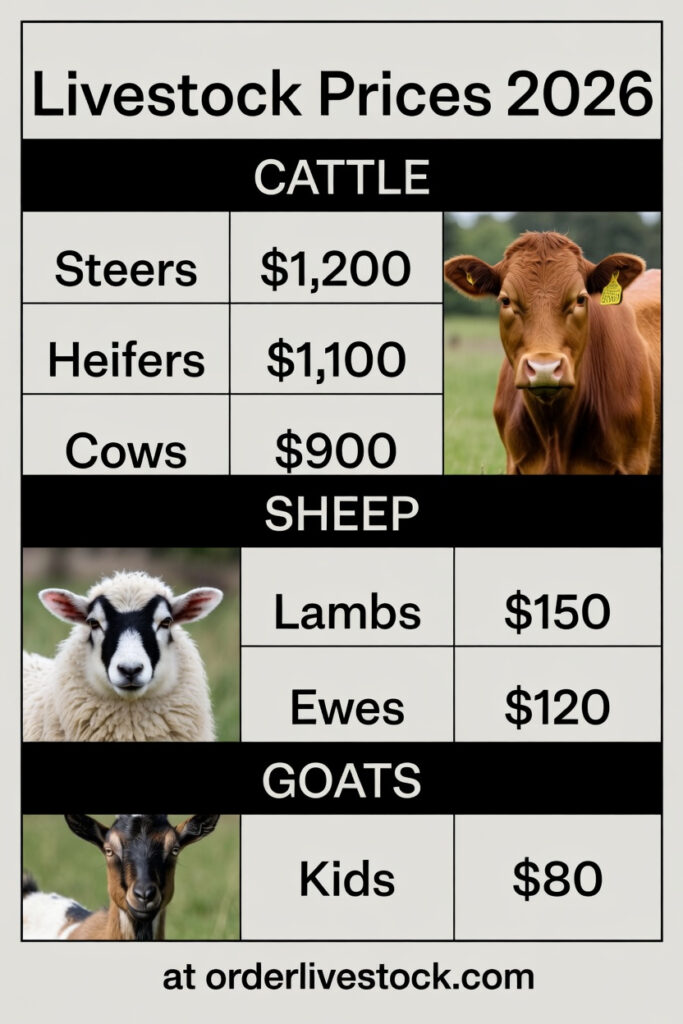
The cattle market in early 2026 shows strength, particularly in the feeder calf sector. Recent sales indicate that well-managed, quality calves command a premium . The cattle price per head varies significantly based on weight.
-
Feeder Steers (Medium/Large Frame):
-
300-400 lbs: $275 – $665 per head
-
400-500 lbs: $200 – $625 per head
-
500-600 lbs: $200 – $545 per head
-
600-700 lbs: $335 – $515 per head
-
-
Feeder Heifers (Medium/Large Frame):
-
300-400 lbs: $225 – $645 per head
-
400-500 lbs: $250 – $535 per head
-
500-600 lbs: $225 – $470 per head
-
-
Bred Cows: A solid investment for immediate herd expansion, ranging from $2,500 to $4,400 per head .
-
Cow-Calf Pairs: The top end of the market, with pairs selling from $2,600 to $5,300 .
-
Veal Calves: Quality “drop” calves (baby calves) are trading strongly, from $1,200 to $2,450 per head .
2026 Insight: There is consistent demand for medium-to-large frame steers and heifers. “High Yielding Individual” slaughter bulls have recently peaked at $2.15/lb, indicating packers are willing to pay for quality .
Sheep Market Overview & Sheep Price Per Head
The sheep market demonstrates clear stratification by weight, with lighter, finished lambs often fetching a higher price per pound due to their desirable carcass size. The average sheep price per head is detailed below.
-
Feeder Lambs (by weight):
-
49 lbs and less: $550 – $625 per head
-
50 – 64 lbs: $535 – $590 per head
-
65 – 79 lbs: $460 – $505 per head
-
80 – 94 lbs: $370 – $425 per head
-
95 – 109 lbs: $357.50 – $382.50 per head
-
110 lbs +: $345 – $357.50 per head
-
-
Mature Sheep (All weights): $180 – $325 per head
-
Ewes: Quality breeding ewes, such as Dorset or Texel crosses, are listed between $300 and $400 .
-
Rams: Registered and proven rams with good genetics can range from $400 to $600+ .
2026 Insight: The premium on lightweight lambs (under 80 lbs) is evident, making them a strong candidate for feeding and finishing programs.
Goat Market Overview & Goat Price Per Head
The goat market remains robust, driven by strong demand from diverse ethnic markets and the rising popularity of goat meat for its lean qualities. The goat price per head is highly dependent on breed and purpose (breeding vs. meat).
-
Mixed Market Goats (All Weights): A broad category ranging from $150 to $290 per head, with top-quality specimens reaching $495 .
-
Specialty Breeds (Galla & Boer):
-
Galla Goats: Known for hardiness and twinning. Young does (breeding age) sell for ~$1,600, and bucks for ~$2,100 (KES equivalent converted) .
-
Boer Goats: The premier meat breed. High-quality Boer bucks can command premium prices, from $10,500 to $16,000+ for top genetics .
-
Galla/Boer Crosses: A popular, hardy choice, selling for around $4,800 .
-
2026 Insight: Buyers are willing to pay a significant premium for purebred, registered, and well-vaccinated animals with documented genetics .
Pig Market Overview
While specific per-pound data is scarce in recent reports, the pig market is active with strong demand for both feeder pigs and breeding stock.
-
Feeder Pigs: Crossbred feeder pigs are consistently available, with prices around $85 per head .
-
Breeding Stock: Crossbred boars are valued around $275, while specialty breeds like Kunekune (often kept as pets or for grazing) have asking prices around $300-$400 .
2026 Insight: Biosecurity is a major concern in swine. Buying from reputable sources like those on OrderLivestock.com ensures you are getting healthy animals with proper health protocols.
Complete Buyer’s Guides by Species
How to Buy Cattle: Breeds and Tips
Buying cattle is a significant investment. Here’s what you need to know.
-
Recommended Breeds:
-
Angus: The industry standard for high-quality beef, known for marbling and calving ease.
-
Holstein: Excellent for dairy operations, but also used in dairy-beef cross systems for efficient growth .
-
Limousin & Charolais: Continental breeds prized for their heavy muscling and lean carcasses, ideal for beef production .
-
Hereford: Docile, hardy, and excellent foragers, making them great for grass-fed operations.
-
-
Buyer Tips:
-
Check the Frame: Look for “Medium/Large Frame” scores, which generally indicate better growth potential .
-
Verify Health: Ensure vaccinations are up-to-date and ask about the herd’s health status (e.g., IBR-negative) .
-
Clarify Purpose: Are you buying stockers to graze, feeders to finish, or breeding stock? This dictates the type of animal you need.
-
Inspect Confirmation: Look for animals with a strong top line, good feet and legs, and a healthy, alert appearance.
-
How to Buy Sheep: Breeds and Tips
Sheep are versatile and can be a great addition to any farm.
-
Recommended Breeds:
-
Katahdin & Dorper: Excellent “hair sheep” breeds that do not require shearing, are parasite-resistant, and have good maternal instincts. A fantastic low-maintenance choice .
-
Dorset: Prolific breeders that can lamb year-round, known for their medium wool and good milk production .
-
Hampshire & Suffolk: Traditional meat breeds known for rapid growth and muscular carcasses.
-
Wiltshire: A shedding breed with excellent fertility and worm resistance, perfect for low-input systems .
-
-
Buyer Tips:
-
Understand Weight Categories: As seen in the pricing data, lamb weight drastically affects price. Decide if you want light feeders or heavy slaughter lambs .
-
Inspect Mouth and Feet: Check for healthy teeth and sound feet, free from rot or scald.
-
Ask about Parasite Management: Select for breeds or individuals with proven resistance to internal parasites .
-
How to Buy Goats: Breeds and Tips
Goats are intelligent and profitable, but choosing the right breed is key.
-
Recommended Breeds:
-
Boer: The top choice for meat production. They are large, fast-growing, and produce a heavy muscled carcass .
-
Galla: A hardy, indigenous breed from Kenya. They are heat-tolerant, resistant to diseases, and known for twinning (double kindling) .
-
Spanish Goats: Extremely hardy and well-adapted to rough terrain and forage-based systems.
-
Kiko: Bred for hardiness and rapid growth in non-intensive systems, making them excellent for crossbreeding.
-
-
Buyer Tips:
-
Define Your Market: The price for a high-end Boer buck is vastly different from a market wether .
-
Check Vaccination Status: For goats, vaccinations for diseases like Enterotoxemia (Clostridium) are critical .
-
Evaluate Body Condition: Look for goats that are alert with bright eyes, a healthy coat, and good body condition for their age and type.
-
How to Buy Pigs: Breeds and Tips
Whether for meat or breeding, pigs require specific care.
-
Recommended Breeds:
-
Yorkshire & Landrace: The foundation of most commercial herds, known for excellent maternal traits and large litters.
-
Duroc: Renowned for meat quality, marbling, and fast growth, often used as a terminal sire.
-
Berkshire: A heritage breed famous for its flavorful, dark meat highly sought after by chefs and niche markets.
-
Kunekune: A small, hairy breed from New Zealand that thrives on grass, making them ideal for smallholdings and pasture pig systems .
-
-
Buyer Tips:
-
Prioritize Biosecurity: Pigs are susceptible to diseases. Only buy from farms with strict health protocols.
-
Decide on Genetics: Are you looking for purebreds for breeding or crossbreds for feeder pigs? Crossbreds offer hybrid vigor for commercial meat production .
-
Check for Hernias: Inspect the belly area for umbilical or scrotal hernias, which can be a genetic defect.
-
Essential Farm Tips for New Stock
Bringing new animals home is a critical time. Follow these tips to ensure a smooth transition:
-
Quarantine New Arrivals: Always isolate new animals for a minimum of 2-4 weeks to monitor for signs of illness before introducing them to your main herd or flock.
-
Prepare Facilities in Advance: Have clean, dry, and well-ventilated pens ready. Ensure fencing is secure to prevent escapes, especially with goats and sheep.
-
Plan for Nutrition: Know what the animals were eating previously and have that feed on hand. Gradually transition them to your chosen feed over 7-10 days to avoid digestive upset.
-
Establish a Working Relationship with a Vet: Have a local veterinarian perform a health check on your new arrivals and establish a vaccination and deworming schedule.
-
Invest in a Handling Unit: For larger operations, a good handling unit (chute, headgate, scales) makes managing cattle and other livestock safer and less stressful for both you and the animals .
Frequently Asked Questions (FAQ)
1. Is it safe to buy livestock online without seeing them in person?
Yes, when using a reputable platform like OrderLivestock.com. We encourage sellers to provide detailed photos, videos, and comprehensive health records. Many online platforms also offer third-party verification or allow for farm visits by appointment, similar to the transparency seen in modern online auction models .
2. How does shipping work when I order livestock?
Once a sale is finalized, the marketing team or platform (like OrderLivestock.com) can help coordinate shipping. Reputable sellers and platforms work with specialized livestock transporters who are experienced in handling animals safely and humanely. The animals are typically shipped directly from the seller’s farm to yours .
3. What factors most affect cattle price per head?
The cattle price per head is primarily influenced by weight, frame size, flesh condition, and sex. Other factors include breed, genetic potential (for breeding stock), health status, and current market supply and demand .
4. What is the current trend for sheep price per head in 2026?
Current data shows that lighter-weight feeder lambs (under 80 lbs) are fetching a higher sheep price per head compared to heavier slaughter lambs, indicating strong demand for stock to finish. Hair sheep crosses like Katahdin and Dorper remain popular for their low-maintenance qualities .
5. Why is goat price per head so variable?
The goat price per head varies widely because the market serves different purposes. Purebred breeding stock (like Boer or Galla) commands high prices due to their genetics. Market goats for meat are priced by weight and condition, while “brush goats” for vegetation control may sell for less .
6. Do I need special facilities to raise pigs?
Pigs require secure fencing (electric fencing works well) to prevent rooting and escape. They need shelter from sun and wind, a constant supply of fresh water, and a diet appropriate for their age (grower, finisher, or breeder). Wallows can help them regulate temperature.
7. How can I find specific livestock breeds for sale?
Using an online marketplace like OrderLivestock.com is the most efficient way. You can search specifically for breeds such as “Registered Angus Bulls,” “Katahdin Ewes,” or “Boer Goats,” filtering by location and price to find exactly what you need .
Conclusion: Secure Your Livestock Today
Navigating the livestock market in 2026 requires knowledge, timing, and access to quality animals. Whether you are looking to expand a commercial herd with top-tier genetics or start a small homestead flock, understanding market prices like cattle price per head and sheep price per head is your first step toward success. The data shows a healthy market with opportunities for buyers who are prepared to invest in quality.
Don’t settle for the limited selection at your local auction barn.
At OrderLivestock.com, we connect you with verified sellers and a vast inventory of healthy cattle, sheep, goats, and pigs. From high-quality Galla goats to premium feeder steers, your next great investment is just a click away.

